How to advertise commercial property on Facebook (2026)
3 November 2026
To advertise a commercial property on Facebook and Instagram in Australia, run a Meta campaign built around the listing. Target a radius around the site plus business and commercial property interests, put sale or lease and the size in the first line, and time the budget to your deadline.
That's the short answer. Below: who to reach, what to say, how long to run it, and which rules apply here. Spoiler: mostly not the American ones.
Last updated 3 November 2026. Written by Properti, an AI marketing platform for Australian real estate, for commercial sales and leasing agents.
How do you advertise a commercial property on Facebook, step by step?
Set the deadline, pick a Meta objective, build the audiences, write a specific first line and size the images. Then run the ads from listing day to the deadline.
Set the deadline. The expressions of interest (EOI) close, the auction, or the date the landlord wants a tenant in.
Pick the objective. In Meta Ads Manager, choose Traffic to send people to the listing page, or Leads to collect enquiries by message, phone call or sign-up form. Meta's guide to choosing an ad objective explains each option.
Build the audiences. A radius around the site, commercial property interests, and your own database as a customer list. Give each one its own ad set.
Write the first line. Sale or lease, size, suburb and the one feature that sells it. Meta's ads guide recommends 50 to 150 characters of primary text for a Facebook Feed image ad.
Size the images. Meta recommends 4:5 (1440 x 1800 pixels) for Facebook Feed and 9:16 (1440 x 2560) for Instagram Stories.
Launch on listing day. Ads that start in week four are rescuing a campaign, not running one.
Stop at the deadline and count enquiries. Calls, enquiries and inspections booked. Not likes.
Do Facebook ads work for commercial property?
Facebook and Instagram ads work for commercial property when you need people who aren't searching yet, like business owners and investors. They won't replace the portals.
Portals are built for intent. Great, if your next tenant is already searching. Plenty aren't. The physio who's outgrown two rooms. The investor who'd buy a decent warehouse if one turned up. They're on their phones, just not on a portal.
In late 2025, Meta's ad tools put Facebook's ad reach in Australia at 17.7 million users and Instagram's at 15.2 million, according to DataReportal's Digital 2026: Australia report. Ad reach isn't a headcount, but you get the idea.
For office leasing, there's also more empty space chasing the same tenants. Australian office vacancy rose from 15.8 to 16.1 per cent in the six months to July 2026, according to the Property Council's Office Market Report. That's office only, and it's measured by floor space: about a sixth of Australia's office space is sitting empty.
Portals catch the people already looking. Facebook and Instagram catch the ones who will be.
Where does Facebook fit in a commercial campaign?
Facebook and Instagram sit alongside the portal listing in a commercial campaign, not instead of it. Each channel reaches a different person, so a good campaign uses most of them.
The last row isn't a typo. Commercial clients Google you too.
When is a paid campaign worth it?
A paid Facebook campaign is worth it when the listing is big enough, or the deadline tight enough, that more of the right eyes changes the result. That's judgement, not science, so here's ours.
Worth paying for:
A sale with an EOI close date, where qualified enquiry before the close is the whole game.
A lease aimed at local operators: retail strips, cafés, medical suites, trade units.
An investor-grade asset where the buyer pool is wider than your phone list.
A site that's hard to picture. A yard, a mezzanine and three roller doors sell better as photos.
Probably not:
A small suite that would lease off the board in a fortnight anyway.
A specialist asset with twelve likely buyers you already know. Call them.
Have the money conversation early. If the vendor or landlord is paying for marketing, put paid social in the marketing proposal when you pitch, not three weeks in when the phone goes quiet.
Who should a commercial property ad target?
A commercial property ad should target three groups: people near the site, people who look like buyers or tenants, and people who already know you. Use all three, as separate ad sets. Stack them in one audience and you're asking for people who match all three, which can be a very small crowd.
Location. A radius around the site. Tighter for a retail lease, wider for an investment sale.
Interests. Meta's detailed targeting has interest options such as commercial property. Options change, so check what's in Ads Manager on the day.
Your own database. Past vendors, buyers, landlords and tenants, uploaded as a Meta customer list audience. Only upload contacts you collected yourself, for a purpose your privacy policy covers. The OAIC's guidance on APP 7, direct marketing covers when you can use personal information to market to people.
The radius finds the locals, the interests find the investors, and the database finds the people who already trust you.
What should a commercial property ad say and show?
A commercial property ad should say sale or lease, where, how big, and why this site: whatever a tenant or buyer needs to decide whether to call. The rest can wait for the inspection.
What goes in a commercial listing ad:
Sale or lease, first. "For lease", "For sale" or "For sale or lease", in the first few words. Nobody should have to click to find out.
Size, suburb and the deal-maker. Square metres, the suburb and the one feature that sells it: zoning, parking, roller doors, exposure or access.
The numbers you can show. Rent, outgoings or a price guide, if your client is happy to show them. Don't assume the listing feed carries them. Add them by hand.
Images that answer questions. Street frontage, an aerial or site plan, the floor plan, then the inside. In commercial, the floor plan often does more selling than the hero shot.
One call to action. Enquire, book an inspection or request the information memorandum. Pick one.
The close date. If EOIs close on a date, say so. Deadlines get people moving.
Facts you can back up. Size, zoning and permitted use exactly as documented. Section 18 of the Australian Consumer Law bans misleading or deceptive conduct, and a Facebook ad counts the same as a signboard. Our guide to avoiding false advertising covers the usual traps.
The shape of a good one, with your details dropped in:
For lease in [suburb]. [Size] sqm [property type] with [feature] and [feature]. [Rent or outgoings, if you can show them]. Call [name] on [number] to inspect.
Short, specific, no exclamation marks. "Unique opportunity!!" is not a feature.
How much should you spend, and for how long?
Set the budget by the deadline and the size of the deal, and run the ads from listing day to that deadline. We couldn't find a published, checkable benchmark for commercial listing ad spend in Australia, so we're not going to invent one. A big sale with a fee to match can carry a proper budget. A small suite probably can't.
Judge it on enquiry, not likes. Calls, enquiries and inspections booked. Reach is nice. It doesn't sign leases.
Refresh long campaigns. If a lease runs for months, swap the images and copy every few weeks so nobody sees the same ad for the fortieth time.
Do US housing ad rules apply in Australia?
Mostly, no. Meta's housing special ad category is required for US advertisers and for anyone targeting the US, Canada or certain parts of Europe. An Australian agency advertising to Australians isn't on that list. A few rules apply everywhere, though.
Most advice online is American. Here's the Australian position, from the platforms' own pages:
Meta's special ad categories. Meta's Advertising Standards require US advertisers to declare housing, employment and financial products and services ads as a Special Ad Category. So must anyone targeting the US, Canada or certain parts of Europe. Targeting investors in the US or Canada? Then it applies to you. Parts of Europe too, so check Meta's page first.
Meta's discriminatory practices policy applies everywhere. Ads must not discriminate on attributes such as race, ethnicity, religion, age, sex, sexual orientation, family status or disability, and Meta says it runs the same policies around the world.
Google's housing limits are US and Canada. Google's personalised advertising policy restricts age, gender, marital status, parental status and ZIP code targeting for housing ads in the United States and Canada.
Advertising an Australian property to Australians? Meta's housing category isn't required. Meta's anti-discrimination rules still are.
Should you post it on LinkedIn as well?
Yes. Post every commercial listing on LinkedIn, on the company page and your personal profile. It's free, and commercial is a business-to-business sale.
LinkedIn's ad tools reported 18.0 million members in Australia in late 2025, per DataReportal. Grain of salt: that counts registered members, not monthly active users, so it isn't directly comparable with the Facebook and Instagram numbers.
The company page is the record. Your personal profile is where people actually know you. Then post the Sold or Leased result, because the next landlord is reading.
What Properti does, and what it doesn't
Properti is an AI marketing platform for Australian real estate. It posts your listings on brand, runs ads on Meta and Google, and asks for and replies to Google reviews. For commercial agents, that looks like this:
Properti Ads: listing campaigns. Pick a commercial listing and a budget. Properti builds the campaign from the listing photos, writes the copy and runs it on Meta, Google or both. Meta and Google pick the audience automatically.
Properti Ads: the advanced builder, if you'd rather drive. Use the ready-made Commercial Property audience (business owners and investors), or a Meta audience from a Rex saved filter or your Agentbox contacts. See integrations for the CRMs that connect.
Properti Social. Sale and lease listings come in from your feed and get posted on brand to the channels you pick: Facebook, Instagram and LinkedIn, including LinkedIn company and personal pages. Sold and Leased posts follow when the deal's done.
Properti Reviews. Ask vendors, buyers, landlords and tenants for a review once the deal's done, then reply to Google reviews from one inbox with AI drafts you approve.

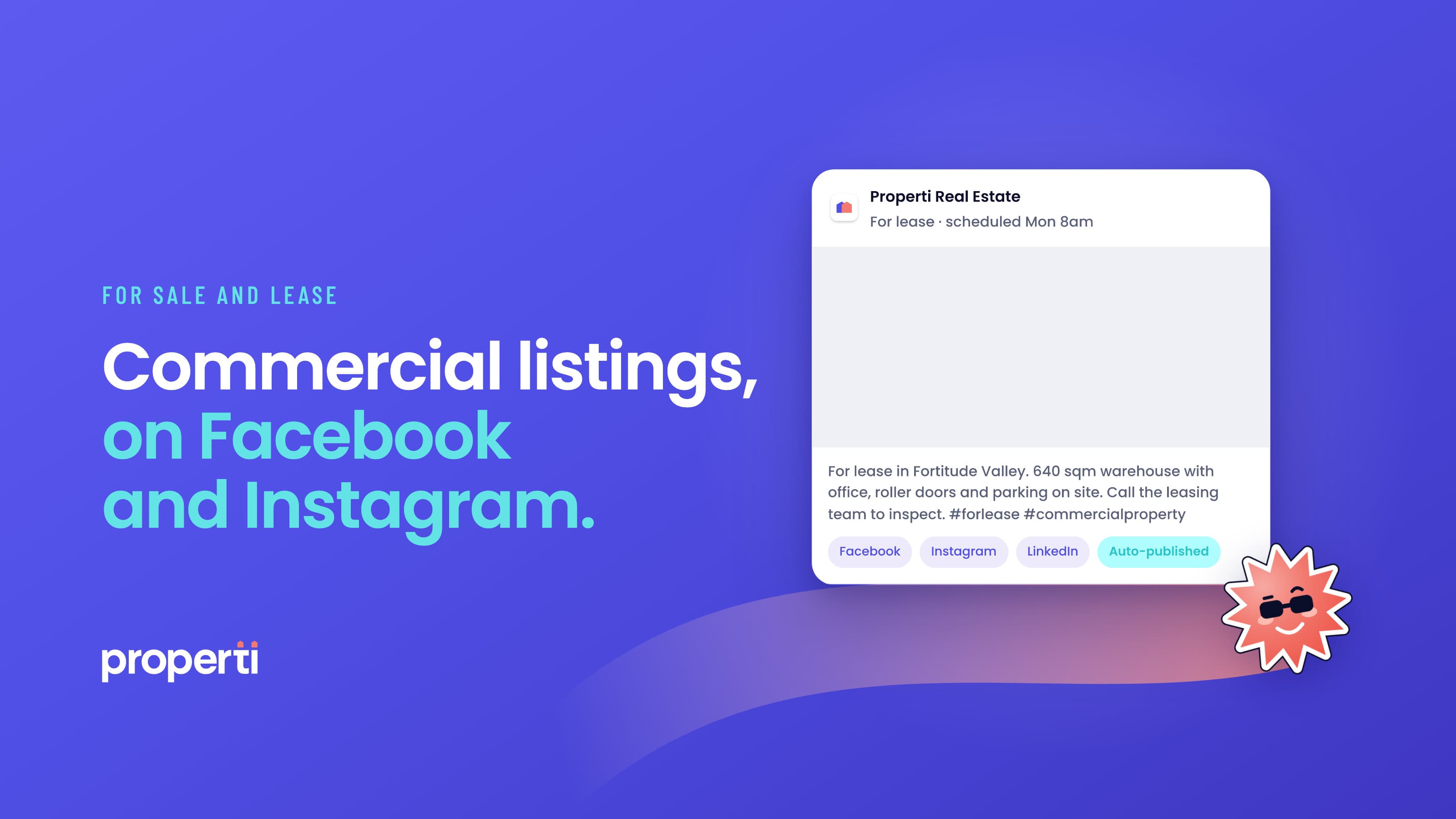
A commercial lease listing, scheduled to Facebook, Instagram and LinkedIn from the listing feed.
What it doesn't do:
It isn't a listings portal. Keep listing on the portals. Properti markets the listing and your brand everywhere else.
Rent, outgoings and lease expiry don't come through the feed. Add them to the price display or the copy.
It posts to LinkedIn but doesn't run LinkedIn ads.
Ads, automations and CRM connections, own-database audiences included, start on the Team plan.
The full rundown is on Properti for commercial.
FAQ
How do you advertise a commercial property for lease on Facebook?
Put "For lease" first, then size, suburb and the feature a tenant needs, such as parking, roller doors or exposure. Add rent or outgoings if the landlord is happy to show them, and run the ads until the date the landlord wants a tenant in.
Can I upload my client database to Facebook for a commercial listing?
Yes, as a Meta customer list audience, but only with contacts you collected yourself for a purpose your privacy policy covers. The OAIC's APP 7 guidance sets out when personal information can be used for direct marketing.
Do I need Meta's housing special ad category in Australia?
No, not when you're targeting Australians. Meta requires it for US advertisers and anyone targeting the US, Canada or certain parts of Europe. Meta's discriminatory practices policy applies everywhere.
Can you run Google Ads on a commercial listing as well?
Yes. Google's housing limits on age, gender, marital status, parental status and ZIP code targeting apply in the US and Canada. Google catches people searching the area. Facebook and Instagram reach people who aren't searching yet.
How much should you spend on a commercial property Facebook ad?
We couldn't find a published, checkable Australian benchmark, so size the budget to the deal and run it from listing day to the deadline. A big sale with a fee to match can carry a proper budget. A small suite probably can't. Judge it on enquiries, not reach.
Does Properti work for commercial-only agencies?
Yes. A Properti workspace doesn't need residential listings. If your listing feed sends commercial listings, that's what Properti markets.
See it on your own listings
Want to see a campaign built from one of your own commercial listings? Book a demo and bring a listing.
Sources
Property Council of Australia, Office Market Report July 2026, Chartbook (August 2026)
DataReportal (Kepios), Digital 2026: Australia (November 2025)
Meta, Advertising Standards: Discriminatory practices (last changed 20 Dec 2024)
Meta, How to choose the right ad objective in Meta Ads Manager
Meta ads guide, image ad specs for Facebook Feed and Instagram Stories
Google Ads, Restricted targeting in personalised advertising
Federal Register of Legislation, Competition and Consumer Act 2010, Schedule 2 (Australian Consumer Law), section 18